

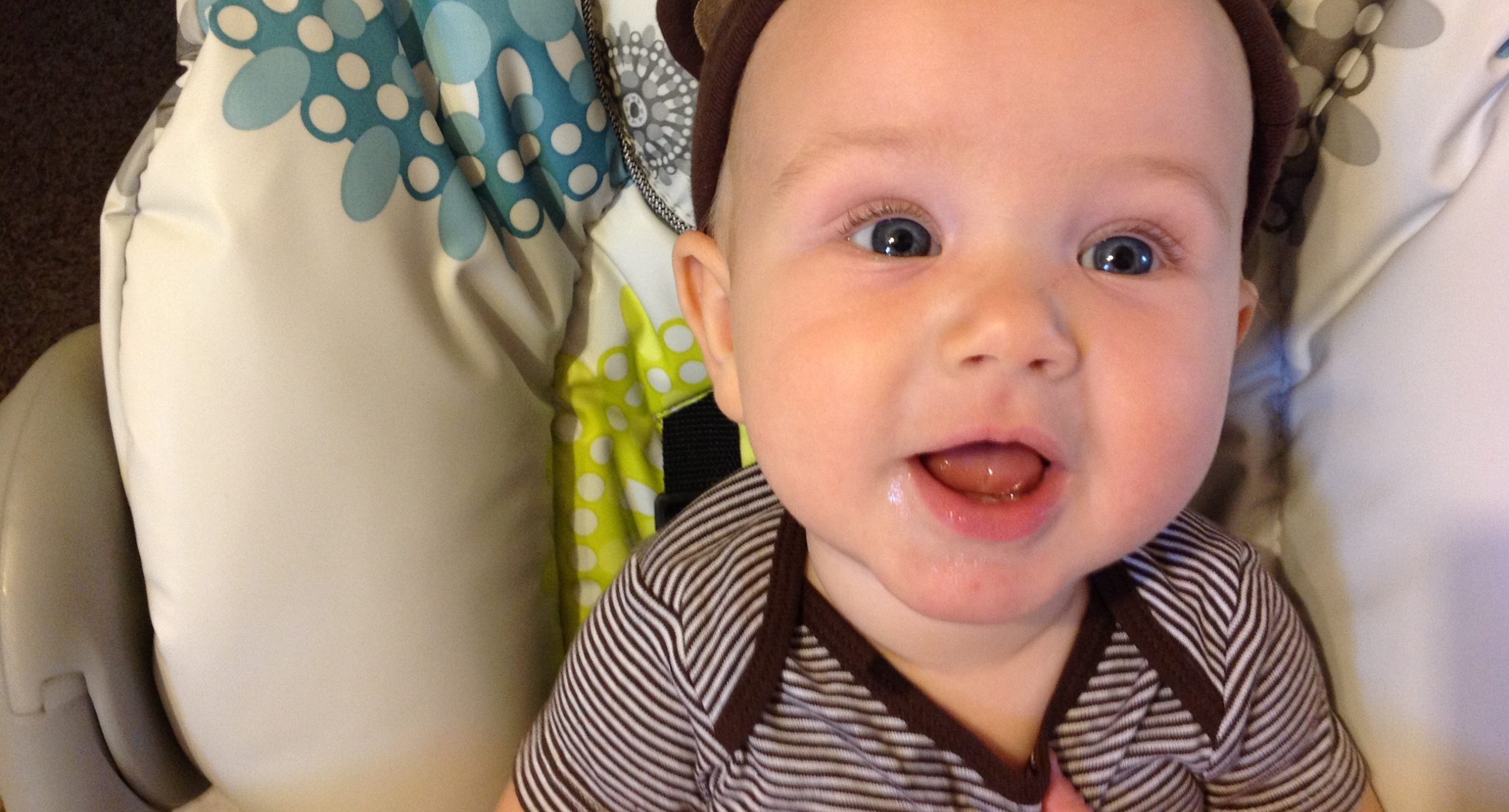
Welcome to the next frontier in infant feeding–adding table food to the booby buffet. This article will guide you through how and when to introduce solids to your baby’s diet.
Signs of readiness
The approximate age to begin offering solids is 6 months, but as with all things, individual babies reach different milestones at different times. With this in mind, we look for indications that the baby’s sensitive digestive tract has matured enough to safely process solid food. Because they weren’t custom engineered for his little body like his milk was, solids are a bigger challenge for his gut, introducing foreign substances to his system.
Offering food before four months of age is plainly contraindicated by a substantial body of literature. The lining of the gut is more fragile and possibly porous, and the digestive system is still learning how to operate. Before four months, solid food carries increased risk of gastrointestinal infections and obesity later in life.
Moreover, national and international guidelines clearly recommend six months of exclusive breast milk feeding as the safest and strongest start for all babies. Once solids are included in the diet, we’re no longer exclusively breastfeeding.
Sitting Upright
Externally, the single easiest sign to recognize is the ability to sit upright unassisted. If you feel at ease walking out of the room when your baby is sitting on the floor, not only does this show that she has sufficient core strength to protect her airway, but it’s also a strong indicator that on the inside, her GI tract has developed sufficiently to handle something new.
Hands to Mouth
Ability to actually pick food up and put it in their mouths is an obvious one–when a baby can literally feed themselves, they are showing that they are ready to start feeding themselves.
Integration of the Tongue Thrust
Thrusting the tongue is a neonatal reflex that prevents babies from swallowing anything solid before they are ready. If you plunk a spoonful of puree onto your baby’s tongue and she thrusts it back out at you, give her more time.
I did not talk about interest in what you’re eating. People swear by this, but this should not be considered readiness without the first three signs present. If your baby is sitting upright on his own, able to bring his hands to his mouth, and no longer thrusts his tongue if a spoon is put into his mouth, he’s probably also curious to try.

First Foods and Nutritional Needs
The first nutritional need of a breastfed infant beyond their mother’s milk is iron. Fetal iron stores meet the baby’s requirements through the first stage of their life, and begin to deplete around six months of age. While there is iron in breast milk (which is better absorbed than the iron in formula), it is not enough to replace these iron stores and so it must be found in food. Great first foods will be good sources of iron, such as sweet potatoes, beans (mashed to avoid choking), meat, and tofu.
Always offer water with solids, as the addition of thicker substances can cause constipation. You can use the Honey Bear Cup or a small toddler cup. Be prepared for lots of messes–this is a critical part of the learning process.
Foods to avoid before one
Honey (risk of botulism), cow’s milk (breast milk and formula have complete nutrition), soft cheeses made with unpasteurized milk (can contain bacteria), and choking hazards (grapes, raw leafy greens, popcorn, etc).
Rice cereal as a first food is an outdated recommendation. Not only is it a processed food, but it has poor nutritional value.
Baby-led or Purees
One way I like to distinguish between baby-led approaches to first foods (letting babies gnaw on foods cut to a size they can grasp) and purees is that the first allows a baby to learn to chew before swallowing, whereas the latter has a baby swallow solids first before learning to chew.
Specialists in facial development tend to favor a baby-led approach, as the emphasis on chewing promotes this optimally. Processed foods, such as crackers and pouches, require less chewing than whole foods.
Proponents of baby-led weaning also point to the impact of responsive feeding on self-regulation and recognizing fullness, as well as how it supports the development of fine motor skills and sensory stimulation.
Purees offer more control to the parent, which is the preference of many families. They also allow you to make your own purees and determine what nutrients are in a given puree mix. It is a mostly passive experience for the infant. Many parents will do a combination of both.

How much and how often?
Milk first
Breast milk and infant formula are more calorically dense than nearly any solid food. If we begin replacing them with whole foods that take longer to digest, then we run the risk of a baby coming up short on her calories. This is why we proceed slowly, offering milk first, and let our baby tell us when he’s ready for more solids and less milk.
Once a day in the first month. Your baby will likely ingest very little, and primarily experiment with this new sensory input.
Twice a day in the second month. You may start to see some changes in poo, a sure sign that it is now going down.
Three times a day in the third month.
Individual babies will move at their own pace, and some will take to solids quickly and begin replacing milk sooner than others. Continue offering milk first, but Baby will ultimately begin taking less milk and more solids as his appetite grows. For the exclusive breastfeeder, less milk can feel alarming. However at this stage, it’s healthy and what we expect!
SUPPLY CHANGES
As your little one starts to be more satisfied with solids than with milk, you’ll have less to replace in his bottles. It can be hard to shift away from the mindset of stockpiling milk, or keeping up with pumping to have enough, towards downregulating your supply. But if you’re finding you have milk consistently left over with the same amount of pumping you were doing before, then it’s a great time for a visit with your lactation consultant to work through how to scale back.
For exclusive nursers, you likely won’t even notice any difference. Your baby will simply take less from the breast, and your breasts will make less. You might pump one day and find you collect significantly less than the last time you checked in; this is okay. It’s the natural order at this point. As long as your baby is gaining appropriately, enjoy the return of this metabolic energy to your own body.
You may find that nursing shifts to less of a “meal time” and more of a “snack time” or way to settle for naps or bedtime. This might feel a little sad, but it also signals a return of space and freedom for you. This is a great time for a friend circle, or quiet time to yourself, to reflect on how far you’ve come, take pride in your hard work and accomplishment, and to grieve if it’s feeling hard to let go. Honor what your body has done for you and your baby, and celebrate this next exciting stage as a mother or parent!